The Docklands
The London Docklands, once the beating heart of London’s global empire, had always been a place where history refused to fade.
Nearly two thousand years ago, when Londinium was still a fledgling Roman settlement, this land had been little more than marsh and riverbank, a natural harbour where merchants and soldiers alike crossed paths. The Romans built their wharves here, unloading cargo from distant provinces—olive oil from Hispania, fine glass from Gaul, amphorae filled with wine from the vineyards of Italia. Trade flourished, and with it, Londinium’s fortunes grew.
Centuries passed, and the river became the city’s lifeline. The Docklands expanded with it, swollen by the wealth of imperial conquest.
Goods poured in like the tide, feeding an empire that stretched across continents. Great warehouses rose, vast and unyielding, their brick facades looming over the water like silent sentinels of dominion. This was the artery through which London’s riches flowed—ivory, silk, spices—all bound for counting houses and stock exchanges, all fueling the insatiable machinery of the City.
Then came war.
Bombs gutted the docks. Firestorms swallowed entire warehouses whole.
On Black Saturday, the London Blitz reduced the Docklands to an inferno, flames devouring centuries of history in a single night. Nearly 500 lives were lost in the chaos—dock workers, firefighters, families who had lived and worked among the wharves. Some never made it out, their remains buried beneath the rubble, their stories consumed by the same fire that razed the docks.
And when the smoke cleared, the empire that had once sustained the Docklands was crumbling. The cranes stood idle, the piers rotted, and the river, patient and relentless, seeped back into the land, reclaiming what it could.
The Docklands became a husk of its former self, its streets left to decay, its history buried beneath steel and glass in the rush to modernise.
But some places resisted erasure—forgotten alleyways. Abandoned shipyards. Derelict corners where the past still pressed against the present, waiting for those who knew where to look. It was here, in the margins of a city that had outgrown its past, that those who sought power beyond their reach came to play.
A place where the past deepened the shadows, where the echoes of old rites still clung to the bones of abandoned wharves, and where the forgotten lingered, the restless dead were never truly silent—
A haven for rituals whispered in the dark, for those reckless enough to stir what should have remained buried.
The night air was thick with the scent of brine, rot, and damp. The Thames sprawled beyond the skeletal remains of the dockyard; its black waters shifted sluggishly under the pale light of a waning moon.
Against its ink-dark expanse, a hollowed-out corpse of a building stood sentinel over the desolation of Silvertown.
Millennium Mills—once a monument to industry—had long since succumbed to decay. Its white concrete facade was streaked with grime, its windows gaping like broken teeth, and its walls still bore the scorched wounds of fire and time. It loomed over the river like a mausoleum for the city’s forgotten ambitions; its silence stretched between the past and the present, waiting for those reckless enough to listen.
In its shadow, two figures knelt beside a chalk-drawn circle on the ground, candlelight flickering against the damp concrete.
The first, draped in dark clothing with a deliberate, theatrical flair, might have been called Gothy by those inclined to label such things. Silver piercings lined his face—across his brow, lip, and nose, extending down to the sharp angle of his jaw—glinting whenever the candlelight caught them.
His companion, at a glance, was more inconspicuous, clad in a black hoodie and worn jeans. Yet, the full-sleeve tattoos coiled around his arms—intricate with runic symbols long lost to living tongues—betrayed something far beyond the mundane.
They were Archaists—not a faction, not a movement, but a scattered collection of believers united by their obsession with Londinium’s mythical past. Some called them visionaries; others, fools; and still others, dangerous. Their feverish conviction burned hotter than reason, an all-consuming belief that the old ways could be restored, that the age of gods and legends might return.
So much so that these two had decided to act upon it
The summoning circle they had drawn was crude, its chalk lines jagged and unsteady, smudged where trembling hands had hesitated. Blood had sealed the invocation, pooling thickly in the grooves where the sigils should have anchored the binding.
What the two did not know was that the lines were flawed, or even incorrect, from the start.
Before they realized it, the air had thickened, pressing against their lungs and making every breath feel weighted. The sigils flared red—too bright, too soon—burning with an intensity that should not have appeared yet.
Then the candle’s wax melted too quickly—more rapidly than anticipated—with thin rivulets hissing as they pooled against the stone, while the flames stretched and flickered unnaturally, bending inward as though something unseen were breathing on them.
The one with the tattoo-sleeve exhaled a sharp, unsteady sound. “They weren’t supposed to do that,” he whispered.
But it was already too late. Something had gone wrong. Terribly wrong.
The thing they had summoned had not stepped through the veil so much as crawled through it, forcing its way into existence in an unravelling of limbs and sinew.
It pulsed between states, its shape never fixed, its skin twisting into patterns that did not belong to any living thing. Where its face should have been, there was a mouth—too wide, too full of teeth—and when it opened, the sound that slithered forth was not a growl or a shriek, but something deeper, something that curled into their lungs and stole the air from their chests.
The gothy one staggered back, his voice catching. “That’s— That’s not—”
The other tried to speak, but his words failed him. His hands had started to shake.
The creature exhaled, and the air grew thick, pressing against their skin as though the very atmosphere rebelled against its presence. The blood on the sigils trembled. The candle flames bent inward. The binding, unstable from the start, splintered beneath them.
The circle collapsed.
The demon moved.
A gust of wind should have followed the motion, a shift in the air, the telltale displacement of space itself—but there was nothing. No sound. No ripple of movement. The creature was simply there, closer than it should have been, its jagged maw stretching into something that might have been a grin.
The two young men looked on in horror, their bodies locked into place, breath shallow, limbs refusing to respond. The summoning had failed—they had summoned something, certainly, but not what they had intended. And it was not contained.
Now, there was nothing between them and whatever had come in its place.
Then, all at once, the light dimmed.
It was not the candles, nor the failing remnants of the sigil—it was the night itself, shifting, deepening.
Shadows stretched unnaturally, thickening at the edges of their vision. The air, already cold, turned sharp, biting against their skin with the wrongness of a winter that did not belong.
And from that darkness, a shape materialized—not stepping into existence, but simply present, as though it had always been there, waiting just beyond the limits of their sight.
Mordred.
They had heard of him, of course. The ghost in the alleys, the myth whispered in Londinium’s underworld. A figure clad in shadow, wreathed in stories of impossible magic and the kind of sorcery no one dared admit was real.
Some said he was a relic of an older age, a remnant of a time when necromancers walked freely. Others swore he was something less than human, a being who had forsaken life for something darker. But stories were just stories—until now.
The flickering light barely touched him, his form wrapped in the deep emerald folds of a hooded cloak that swallowed the glow rather than reflected it.
The mask beneath it gleamed, silver and sculpted into the abstract suggestion of a skull, its hollow gaze fixed upon the creature as though utterly uninterested in the two trembling figures who had called it forth.
He did not speak. He did not move.
The creature hesitated.
For the first time since it had clawed its way into this world, it faltered, its shifting limbs drawing inward as if sensing something greater in the figure that now stood before it.
And then, as if to confirm its fear, Mordred lifted a gloved hand. In its grasp, a dagger.
Not just any dagger.
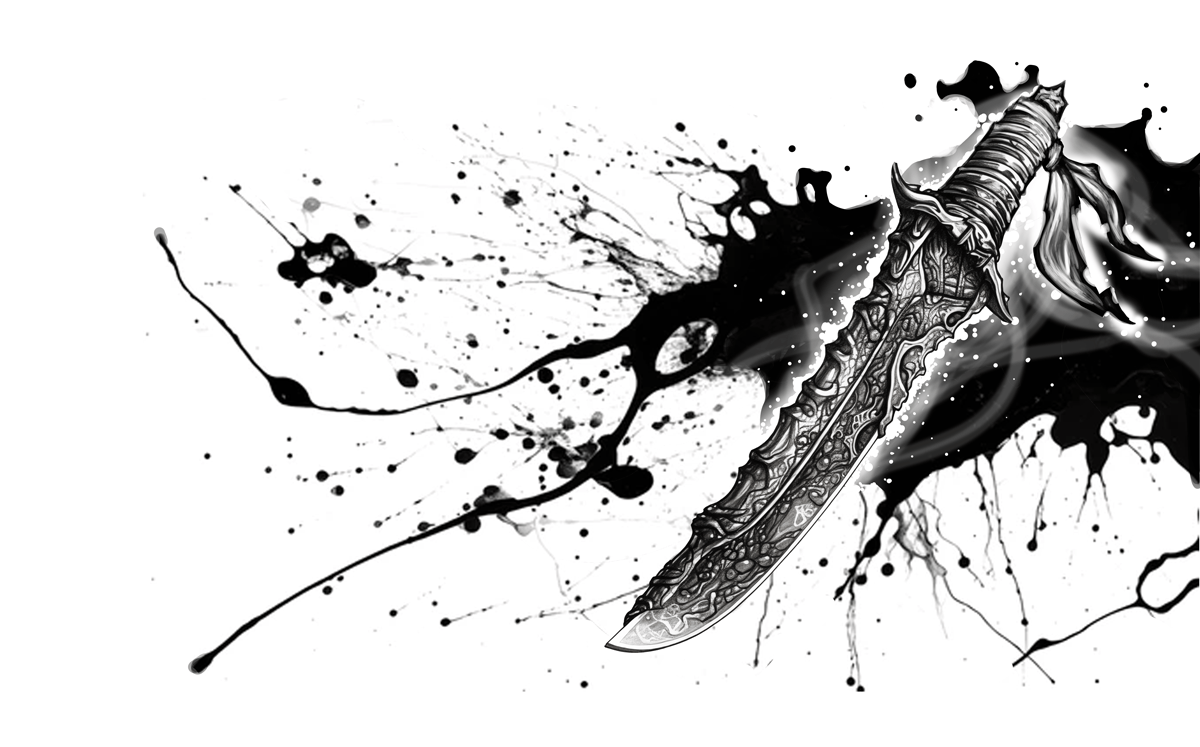
It was a weapon that seemed to drink in the dim light rather than reflect it, an ancient thing, forged from a material so dark it was impossible to distinguish the blade from the hilt. As if the entire weapon had been shaped from a single, unknowable substance.
It was longer than a typical dagger, almost bridging the space between blade and short sword, its surface etched with intricate, unreadable runes.
Londinium’s magic had no record of these markings, no scholars who could decipher their meaning. The ornate patterns wove into one another, twisting into designs that seemed almost alive, shifting subtly if one dared to look too closely.
The summoners did not understand what happened next.
They had read of spells and sigils, of charms and incantations, of the ways magic was meant to be wielded, shaped, understood.
But this—
This was something else.
Mordred spoke.
The words were older than Londinium, older than Latin, older than anything carved into mortal memory. They rolled forth, low and guttural, each syllable pressing against the air like something physical, warping the space around him. The sound did not echo, did not dissipate, but lingered, sinking into the stone, into the marrow of the world itself.
The moment the first syllable left his lips, the demon convulsed.
Its limbs seized, its form twisting unnaturally, Elementum bleeding from its shifting mass like mist drawn to the tide. The creature understood the words, even if the summoners did not. It recoiled, not from Mordred, but from the invocation itself, as though the sound alone was unraveling it from the inside.
This was not magic shaped by the living.
This was command.
The air changed, thickened, darkened. A weight pressed down upon the space around them, a force that did not come from the figure but from something older, something vast, something that should not have been woken.
A sickening pulse rippled outward, and for a single, unbearable moment, they felt it—not the magic, not the spell, but the void beneath it. The absence.
The creature shrieked.
Or it tried. The sound never came, its voice stolen before it could leave its throat.
It flailed, thrashing against an unseen force, its limbs collapsing inward, folding, twisting, tearing itself apart at the seams. Elementum bled from its disintegrating form, luminous and raw, writhing like living smoke as it spiraled upward, drawn toward the dark metal of the dagger in Mordred’s hand.
The runes along its blade pulsed with a sickly glow, drinking deep of the energy as the last vestiges of the creature were consumed. Then, silence.
The air did not return to normal. The night did not breathe again. The summoners stood frozen, their own existence feeling as though it had been reduced to something brittle, something fragile, something that could be snapped just as easily as the creature had been unmade.
Mordred turned.
Neither of them spoke. Neither of them could.
The mask was expressionless, unreadable, but the weight of its gaze settled upon them all the same. And then, finally, his voice—soft, smooth, detached, distorted slightly beneath the silver.
“Well.” A pause. “That was spectacularly idiotic.”
One of them let out a breath too sharp, too fast. The other flinched.
Mordred tilted his head slightly, his gloved fingers idly turning the dagger, watching the last remnants of Elementum flicker against the metal before vanishing entirely.
“Do you have any idea what you nearly unleashed?”
His tone carried no anger, no disdain—only the clinical amusement of someone observing a particularly dull experiment.
“Or were you simply hoping to find out the hard way?”
One of them swallowed. “We—” His voice cracked. “We didn’t mean to—”
Mordred lifted a hand, dismissive. “You thought you could play with fire. Instead, you nearly became kindling.” He paused, tilting his head slightly, his tone shifting into something almost wry.
“Fortunately for you, Hellsing was in need of a meal and, ever the opportunist, it led me here—just in time.”
He turned the dagger between his fingers, watching as the residual glow pulsed along the runes carved into its blade, the last remnants of the creature still flickering within.
“And quite a substantial feast it was,” he mused, as though discussing fine wine.
Then his gaze flicked back to them, sharp as the edge of the weapon itself.
“Which only serves to underscore the staggering depths of your idiocy. What, precisely, did you imagine would happen? That your pet abomination would sit and beg? That it would grant you power in exchange for a few half-formed mutterings and a puddle of blood?”
He let out a slow, deliberate breath, as if disappointed.
“Amateurs.”
The sight of the blade sent a shiver down the spines of the summoners. The gothy one, after what felt like an eternity, managed to find his voice. “You… you killed it.”
Mordred exhaled, quiet, almost bemused.
“Killed?” His grip on the dagger shifted slightly, rolling it in his palm. “No. That would have been wasteful.”
He tapped the flat of the blade against his gloved palm, watching as the residual elementum coiled and dissipated, the runes along its surface pulsing like a slow heartbeat.
“Hellsing devoured it.”
The words were casual, but they carried a finality that made the blood drain from the summoners’ faces.
He studied them for a moment longer, then smiled behind the mask—a slow, deliberate thing that no one could see, but that somehow made itself known all the same.
“And lucky for you,” he murmured, voice dropped into something quieter, silkier, far more dangerous,“ it is full.”
Then, without warning, he moved—not closer, not by much, but enough that the fragile illusion of safety shattered.
“Try not to be fools again,” he murmured, his tone as smooth as a knife slipping between ribs.
“Or next time, I might let Hellsing develop an appetite for something fresher.”
Their faces drained of color so quickly that, had the moment been less dire, it might have been comical.
Mordred seemed satisfied with their reaction.
Without another word, he stepped back into the shadows, letting the darkness swallow him whole. The air remained cold, the space left behind disturbingly empty, as though something fundamental had been removed.
Neither summoner spoke. Neither dared.
Then, finally, in a voice barely above a whisper, one of them asked, “What the hell was that?”
And for the first time, neither of them had an answer.
 LONDINIUM TALES
You must be logged in to post a comment.